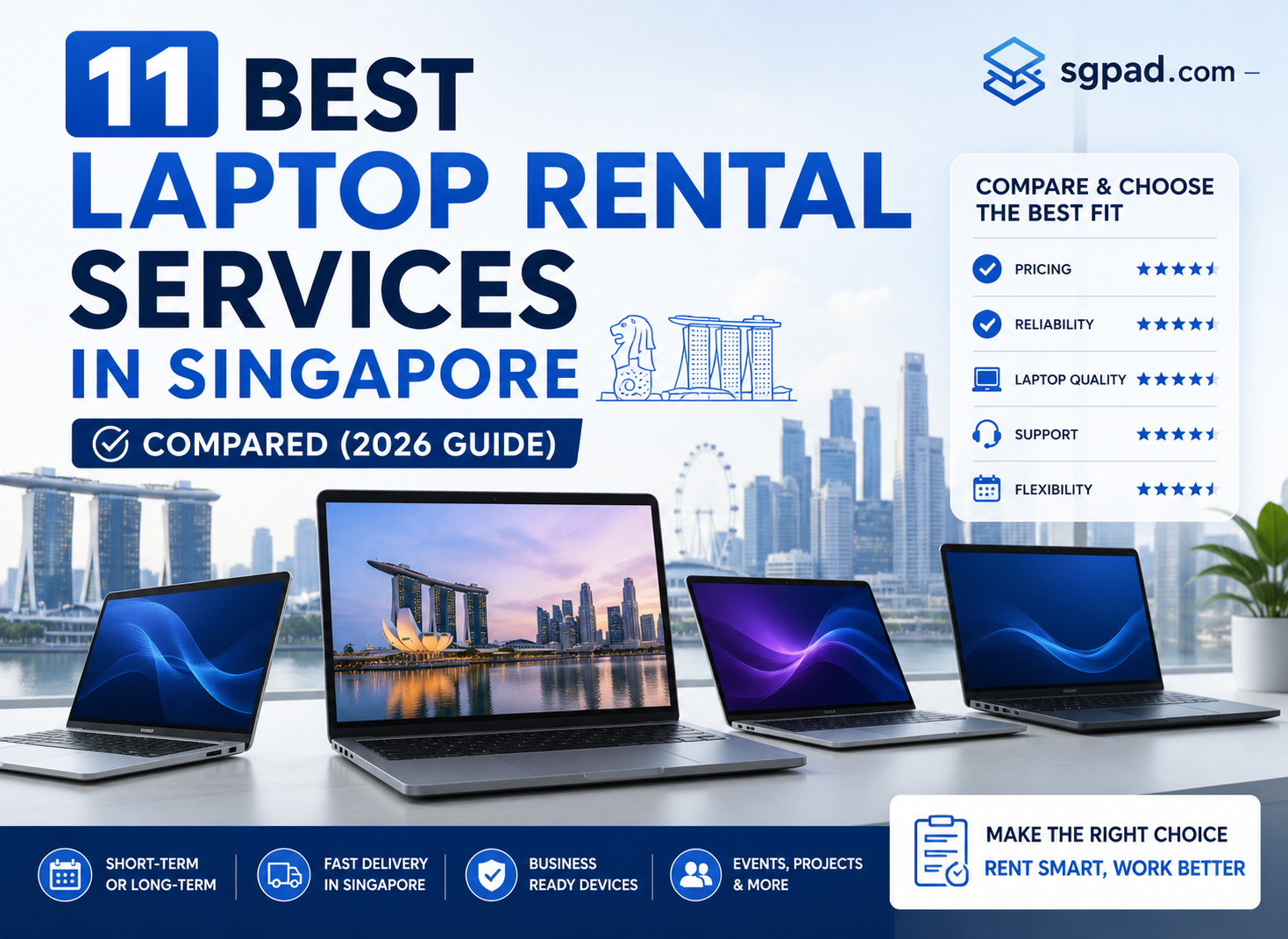
In Year 2026, if talking about the best laptop rental in singapore, A 1-day MacBook Pro rental in Singapore costs between SGD 80 and SGD 150. A 12-month subscription for the equivalent machine works out to roughly SGD 100 per month. A refurbished business laptop on a long-term subscription starts from as low as SGD 19.90 per month. The correct financial choice depends entirely on the deployment duration, the spec required, and whether the renter values capital preservation over long-term ownership.
Singapore is Asia-Pacific’s busiest MICE (meetings, incentives, conferences, exhibitions) destination, and the laptop rental market reflects that density. Event organizers outfitting a three-day Suntec conference face entirely different logistics than a freelance designer needing a six-month MacBook upgrade or a Tuas factory setting up a temporary project office. Match the rental duration to the correct provider model, and companies save up to 60 percent compared to purchasing hardware outright. Choose the wrong provider model — a daily-rate event rental for what becomes a six-week project, for instance — and the cost can quickly exceed the retail price of the device.
This guide compares the 11 most relevant laptop rental operating in Singapore in 2026, covering daily event rentals, monthly consumer subscriptions, B2B corporate fleets, and informal peer-to-peer options. Every entry includes verifiable pricing where the provider publishes it, honest limitations, and the specific customer profile each model serves best.
The state of laptop rental in Singapore in 2026
Two structural shifts have reshaped the local rental market over the past three years. First, asset-light corporate procurement has accelerated as CFOs move away from capital expenditure on depreciating IT hardware. Operating leases qualify as deductible operating expenses under standard IRAS guidance, which makes monthly rental fees easier to budget than three-year capital allowances on owned equipment. Second, the rise of project-based and contract-based work — particularly in tech, fintech, and the creative industries — has created sustained demand for short-term, high-spec machines that traditional retail purchase paths cannot serve efficiently.
The local provider landscape now spans five distinct service models: daily event rentals (Playforce, SGPad), B2B corporate leasing (Technology Rental, JK Tech), consumer subscriptions (Cinch, NowCircular, ITEZ.SG), retail walk-in rentals (Tech For Rent), and informal peer-to-peer (Carousell). Each model carries its own pricing logic, contract structure, and risk profile. Confusing them — for example, expecting a daily event provider to absorb six months of wear-and-tear at the daily rate — is the most common procurement mistake.
GST treatment also affects total cost. Singapore GST has been 9 percent since 1 January 2024. Most established providers quote prices exclusive of GST in B2B contexts and inclusive in B2C contexts. Renters should always confirm whether the quoted price includes GST before signing, particularly on multi-month contracts where the difference compounds.
What to look for in a laptop rental in Singapore
Rental duration flexibility dictates the base pricing model. Singapore providers generally divide into two camps: daily event providers and monthly subscription services. Attempting to rent for a two-day weekend hackathon from a subscription provider usually forces a 30-day minimum lock-in, wasting budget. Conversely, keeping a daily-rate rental for three months results in fees that exceed the retail cost of the machine. Define whether the requirement is 24 hours, one week, one month, or a full fiscal year before evaluating providers.
Laptop model and specification range
determine whether the machine can execute the required workload. Basic data entry, web research, and document work run smoothly on Intel Core i3 or Ryzen 3 processors with 8 GB of RAM, which represent the cheapest laptop rental Singapore options. Demanding workloads — Adobe Premiere video rendering, large-dataset analysis in Python or R, Unreal Engine asset compilation, or running multiple Docker containers locally — require MacBook Pro M4 or M5 chips, or Windows machines with 32 GB of RAM and dedicated NVIDIA RTX-class GPUs. Cross-reference software requirements with the exact model numbers the provider stocks, not generic “business laptop” descriptions. A 2019-vintage Dell Latitude with 8 GB of RAM is a fundamentally different machine from a 2025-spec Latitude with 16 GB and an Intel Core Ultra processor, even though both share the same product line.
Delivery and pickup logistics quietly determine the true cost of the service. Moving a single laptop by courier within central Singapore costs under SGD 20, but transporting 50 units to a Sentosa or Jurong Island event requires secure transit cases, multi-trip scheduling, and on-site setup labor. Most providers offer free delivery for long-term consumer subscriptions but charge logistics fees for specific-hour, same-day, or restricted-area dispatches. Confirm in writing whether the provider supports island-wide delivery, what the surcharge structure is for areas like Jurong Island, Changi Business Park, or Tuas Megaport, who handles return shipping, and whether evening or weekend pickups carry surcharges.
Damage protection and deposit terms represent the largest hidden financial risk in any IT rental. Standard rental contracts hold the renter liable for the full replacement cost of the device if it suffers liquid damage, screen impact, or theft. Premium subscription providers bundle accidental damage protection (ADP) into the monthly fee, absorbing repair costs minus a fixed deductible (typically SGD 100–300). Daily event providers usually require a refundable security deposit ranging from SGD 100 for entry-level units to the full retail value for high-end MacBooks. Read the specific insurance clauses to understand the renter’s exposure if a device is dropped at an event, spilled on, or damaged in transit. The lowest headline rate is rarely the lowest total cost once damage liability is priced in.
Total cost versus buying outright provides the baseline metric for whether renting makes financial sense. The general industry break-even point sits at eight to ten months: if a user requires the machine beyond that point, purchasing usually proves more economical. The math is straightforward — a SGD 1,800 mid-range business laptop rented at SGD 90 per month breaks even against ownership at month 20, but factoring depreciation, service costs, and end-of-life disposal, the practical break-even is closer to month 10. The calculation reverses for current-generation MacBooks. A SGD 2,800 MacBook Air M5 rented at SGD 110 per month breaks even at month 26, but the rental keeps the user current with Apple’s annual hardware refresh cycle. For corporate clients, leasing shifts the expense from capital expenditure (CapEx) to operational expenditure (OpEx), which often aligns better with departmental budgets and IRAS deduction strategies.
Insurance, PDPA, and data security matter for any business rental involving sensitive data. Under Singapore’s Personal Data Protection Act (PDPA), companies remain liable for personal data on rented devices throughout the rental period and during the return process. Reputable B2B providers will issue a Certificate of Data Erasure on return, confirming a multi-pass wipe of the storage drive in line with NIST 800-88 guidance. Daily event rentals rarely require this, but six-month corporate leases handling client data should not be signed without it.
Best Laptop Rental Service Provider Comparison Table
| Provider | Best for | Daily rate (SGD) | Monthly rate (SGD) | Free delivery | Min rental | Damage protection |
| SGPad | Events & short-term | From 40 | From 120 | No (event-based) | 1 day | Optional |
| Playforce | Same-day deployment | From 50 | From 150 | No | 1 day | Optional |
| ElectronicsCrazy | B2B business laptops | From 30 | From 80 | No | 1 day | Optional |
| Cinch | Long-term consumer sub | N/A | From 45 | Yes | 1 month | Included |
| ITEZ.SG | Cheapest refurbished | N/A | From 19.90 | Yes | Varies | Included |
| NowCircular | MacBook M5 subscription | N/A | From 63 | Yes | 1 month | Included |
| Technology Rental SG | Bulk enterprise events | Quote on request | Quote on request | Negotiable | 1 day | Included |
| Tech For Rent | Walk-in physical store | Available | From 60 | No | 1 day | Optional |
| JK Tech | IT equipment bundles | Quote on request | Quote on request | Negotiable | Quote | Included |
| Musicshop SG | Secondary AV event tech | From 45 | N/A | No | 1 day | Optional |
| Carousell P2P | Informal listings | Varies widely | Varies widely | Varies | 1 day | None |
All prices are exclusive of 9% GST unless otherwise noted. Verify directly with the provider before booking.
11 best laptop rental in Singapore
1. SGPad
SGPad specialises in rapid, short-term IT deployments for the Singapore event, exhibition, and corporate training sector. SGPad offers laptop rental, iPad rental, Printer Rental, as well as event wifi rental in Singapore. However, the model bypasses the friction of corporate procurement portals: quotes and orders move via WhatsApp, inventory checks occur in real time during business hours, and standardised event configurations reduce setup time upon arrival. For event managers running roadshows, exhibition booths at Singapore EXPO or Suntec, or one-off training sessions, the operational speed often matters more than the headline daily rate.
Standout features:
- Direct WhatsApp ordering for quotes, inventory checks, and last-minute additions
- Pre-configured event profiles (presentation software, browser shortcuts, Wi-Fi credentials pre-loaded)
- Clean, unbranded hardware suitable for client-facing exhibition booths
- Rapid-response tech support during Singapore business hours, including on-site swap-outs for hardware faults
- Flexible billing for repeat event clients (consolidated monthly invoicing rather than per-event payment)
- SGPad offers laptop rental, iPad rental, Printer Rental, as well as event wifi rental in Singapore.
Pricing: From SGD 40 per day for standard Windows machines (Intel Core i5, 8 GB RAM, 256 GB SSD class). From SGD 120 per month for short-term project rentals. Delivery and on-site setup fees scale with location and unit volume.
Where it fits: Event organisers, exhibition managers, AV production companies, and corporate L&D teams who need reliable hardware delivered to specific venues with minimal procurement overhead. Particularly suited to the 1-day-to-3-week window where subscription providers are too slow to onboard, and retail walk-ins do not scale.
Limitations: SGPad’s inventory is built around standardised event hardware, not niche power-user configurations. Renters needing high-end gaming laptops, RTX 4090-class workstations, or specific developer-focused machines (e.g., a fully maxed-out MacBook Pro M5 with 64 GB unified memory) may find inventory limited. Long-term subscriptions beyond six months are not the core business model.
2. Playforce
Playforce targets the premium short-term rental market, positioning itself around urgency and high-end inventory. The brand is the recognised fallback when a journalist’s MacBook fails the night before a conference, when a director arrives in Singapore for a client pitch with a damaged machine, or when a creative agency suddenly needs a gaming-spec laptop for a brand activation. Same-day delivery within mainland Singapore is the operational signature.
Standout features:
- Same-day delivery available across mainland Singapore, including Sentosa for an additional fee
- Strong inventory of high-performance and gaming laptop rental Singapore options (ROG, Razer, Alienware tiers)
- Transparent online booking with a real-time availability calendar
- Flexible extension policies for renters whose short-term needs unexpectedly stretch
- MacBook and iPad rentals available alongside Windows machines (relevant for Apple-only creative teams)
Pricing: From SGD 50 per day for standard Windows machines, SGD 80–150 per day for premium MacBook Pros and gaming laptops. Monthly rates from SGD 150. Weekly rates around SGD 150 for entry-level units.
Where it fits: Freelancers and creative professionals on tight deadlines, visiting executives requiring immediate hardware on arrival, agencies running last-minute brand activations, and gamers needing high-spec machines for short-duration tournaments or LAN events.
Limitations: Daily rates for premium models scale rapidly, making Playforce expensive for stays beyond two to three weeks — a 21-day MacBook Pro rental at SGD 100 per day costs more than a 12-month NowCircular subscription on the same machine. The premium positioning also means budget-conscious renters and students will find more affordable alternatives elsewhere.
3. ElectronicsCrazy
ElectronicsCrazy operates a broad e-commerce platform that includes a dedicated B2B IT rental division. The focus is on standardised business-grade laptops from Lenovo (ThinkPad, IdeaPad), Dell (Latitude, OptiPlex), and HP (EliteBook, ProBook). The business model serves SMEs and project-based teams that need functional, no-frills hardware without paying premium markups for branding or rapid fulfilment.
Standout features:
- Deep inventory of standardised enterprise-grade machines, particularly Lenovo ThinkPads and Dell Latitudes (the workhorse class for finance, professional services, and government contractors)
- Tiered B2B pricing that aggressively discounts long-term leases and bulk orders
- Bundle options for monitors, projectors, printers, and other office electronics
- Standard corporate invoicing with NET-30 payment terms for verified business accounts
- Walk-in collection from their Halcyon Building location in Jalan Pemimpin
Pricing: Daily rates from SGD 30 for standard business laptops. Monthly rates from SGD 80 for basic configurations (Intel i5, 8 GB RAM). Volume discounts apply at 10+ units. MacBook rentals available at higher tiers.
Where it fits: SMEs onboarding temporary staff, project consultancies setting up contractor workstations, audit firms needing client-site machines, and companies running quarterly training programs that recycle hardware between sessions.
Limitations: The rental section sits within a broader e-commerce site, which can make navigation less intuitive than dedicated rental platforms. Consumer-facing support response times are slower than B2C-only competitors, and the brand identity skews toward business buyers — individual consumers and event managers may find the experience less polished than at Playforce or SGPad.
4. Cinch
Cinch operates strictly on the device-as-a-service subscription model, treating laptops the way telecom companies treat smartphones: a fixed monthly fee, a curated catalog of current-generation devices, and protection bundled into the contract. The model targets consumers and remote workers who want predictable monthly costs and the option to upgrade hardware without managing depreciation or resale.
Standout features:
- Built-in accidental damage protection is included in the standard monthly fee (rare in the local market)
- Curated selection of current-generation devices, including MacBook Air M-series, MacBook Pro M-series, and high-end Windows ultrabooks
- Zero-deposit rentals for users who pass digital credit checks
- Free delivery and free return shipping across Singapore for active subscriptions
- Buy-out options at the end of long-term contracts (the device can be purchased at residual value)
Pricing: Monthly rates from SGD 45 for entry-level Windows devices. Mid-range MacBooks SGD 100–140 per month. High-end MacBook Pro M-series SGD 150–200 per month. Lower advertised rates require 6-to-18-month commitments. No daily rates available.
Where it fits: Students wanting predictable monthly costs without parental capital, remote workers and freelancers running multi-month projects, expatriates on 12-month contracts who do not want to ship hardware on departure, and individuals building toward a home office without a large upfront purchase.
Limitations: Cinch requires a minimum one-month commitment and incentivizes 6-to-12-month contracts to unlock the lowest advertised rates — early termination usually triggers a fee. The provider does not service same-day event rentals, daily walk-ins, or bulk corporate fleet orders. Subscription credit checks may exclude renters without local employment history or established Singapore credit footprints.
5. ITEZ.SG
ITEZ.SG occupies the budget-conscious and sustainability-focused end of the consumer subscription market. The model intercepts corporate off-lease laptops at the end of three-to-four-year cycles, refurbishes them locally, grades them by physical condition, and re-deploys them on monthly subscriptions to students, startups, and budget-sensitive renters.
Standout features:
- The lowest entry point in the Singapore market: refurbished units start from SGD 19.90 per month
- Strong sustainability angle aligned with Singapore Green Plan 2030 messaging — extending the operational lifecycle of functional IT hardware
- Transparent grading system (cosmetic condition disclosed before checkout)
- Straightforward upgrade paths when newer refurbished generations enter inventory
- Free islandwide delivery on standard subscription orders
Pricing: Subscriptions from SGD 19.90 per month for older-generation refurbished Windows laptops (e.g., Lenovo IdeaPad 14ADA7 with AMD-3020e, 4 GB RAM, 128 GB eMMC). Higher-spec refurbished units, including refurbished ASUS V16 models, range up to SGD 71.90 per month. New-condition units carry separate pricing tiers.
Where it fits: Students at NUS, NTU, SMU, polytechnics, and ITEs needing a basic machine for assignments and lectures; tertiary education users on tight monthly allowances; bootstrapped startups running early-stage operations on minimum hardware spend; second-machine setups for households needing an extra laptop for occasional use.
Limitations: Refurbished hardware is by definition older — typically three to five years old — and battery life rarely matches new-condition specifications. RAM and storage on entry-level units (4 GB / 128 GB) limit the workloads the machine can handle; demanding software like Adobe Creative Cloud, modern game engines, or 4K video editing will perform poorly. The cosmetic grading system means some units have visible wear, which matters for client-facing professional use.
6. NowCircular
NowCircular operates exclusively in the premium consumer subscription space, with near-singular focus on the Apple ecosystem. The provider is the clearest specialist in Singapore for users who want immediate access to current-generation Apple Silicon hardware without the depreciation curve of outright purchase.
Standout features:
- Immediate access to the newest Apple hardware, including MacBook Air M5 (13″ and 15″), MacBook Pro M5, and MacBook Pro M5 Pro
- Seamless device swap-outs in the event of hardware failure (covered by AppleCare-equivalent service)
- Upgrade paths timed to Apple’s annual hardware refresh cycle
- Modern subscription dashboard for managing billing, upgrades, and end-of-term decisions
- Supplementary iPad and iPhone rental options for renters consolidating Apple device subscriptions
Pricing: MacBook Air M5 13″ subscriptions from SGD 63 per month. MacBook Air M5 15″ from SGD 74 per month. MacBook Pro 14″ M5 Pro from SGD 117 per month. Higher-spec configurations (32 GB+ unified memory, 1 TB+ storage) sit above these starting rates. Minimum commitment terms apply.
Where it fits: iOS and macOS developers, graphic designers, video editors and motion designers, photographers, Apple ecosystem loyalists who want to rent a MacBook in Singapore without the SGD 2,500–5,000 retail outlay, and creative professionals who need to stay on the latest Apple Silicon for performance reasons.
Limitations: The strict focus on premium Apple devices and select high-end Windows machines means there are zero options for users seeking ultra-budget hardware. Renters on fixed budgets below SGD 60 per month should look at ITEZ.SG or Cinch’s entry tier. The Apple-centric model also excludes users in workflows that require Windows-only software (specific CAD packages, certain financial trading platforms, some enterprise enterprise resource planning systems).
7. Technology Rental Singapore
Technology Rental Singapore operates exclusively in the high-volume B2B segment. The provider does not cater to individuals; the business model is built around supplying fleets of identical, identically configured devices for major corporate functions, standardized testing environments, government-organised exams, and large-scale tech conferences. Inventory depth and imaging capability are the structural advantages.
Standout features:
- Capability to deploy hundreds of identically-configured laptops simultaneously (relevant for IT certification exams, corporate training, and conference workstations)
- Advanced staging services, including custom imaging, group policy pre-configuration, and software pre-loading across the entire fleet
- On-site technical support teams dispatched for large-scale events
- Multi-day event coverage with replacement units held in standby for hardware failures
- Established a global logistics network for multi-national events routing through Singapore
Pricing: Entirely quote-based, scaling with unit volume, imaging requirements, contract duration, and on-site support inclusion. Single-unit rentals typically not accepted.
Where it fits: Enterprise IT directors deploying hardware for multi-site training programs, exam administration bodies running standardised digital assessments, conference organisers running hands-on training sessions for hundreds of delegates simultaneously, and multi-national companies routing tradeshow assets through Singapore as a regional hub.
Limitations: The business model explicitly rejects single-unit rentals and standard consumer inquiries. Minimum order quantities apply, often starting at 20+ units. The procurement process involves project scoping calls and signed service agreements rather than instant booking, which extends lead time. Pricing transparency is limited — renters cannot evaluate the offer without engaging the sales process.
8. Tech For Rent
Tech For Rent operates a traditional brick-and-mortar rental model from a physical location at 261 Waterloo Street. The business serves Singapore renters who prefer in-person transactions, want to physically inspect hardware before signing, or value direct face-to-face troubleshooting over digital subscription management.
Standout features:
- Physical storefront where customers can test keyboard feel, screen quality, and battery condition before committing
- Immediate walk-in fulfillment for available on-hand inventory
- Direct access to in-house technicians for live troubleshooting during the rental period
- Cash, PayNow, and standard retail payment options accepted on-site
- Strong word-of-mouth reputation in the central Singapore area, reflected in consistent five-star Google reviews
Pricing: Monthly rates from approximately SGD 60 for entry-level units. Daily rates available for short-term needs. Rates negotiable on longer commitments.
Where it fits: Local residents and walk-in renters in central Singapore, older demographics who prefer traditional retail interactions over digital platforms, renters who specifically want to inspect a unit before paying, and users with one-off needs who do not want to onboard onto a subscription platform.
Limitations: Inventory depth is constrained by physical shop space, which means bulk orders, large-event fulfillment, and specific high-end configurations require lead time and may not be feasible at all. The physical-store model also limits operating hours — same-day late-evening or weekend pickups depend on shop hours, unlike online providers offering 24-hour booking. No subscription model means longer rentals lack the structured discount tiers available at Cinch or ITEZ.
9. JK Tech
JK Tech functions as a comprehensive IT solutions provider that treats laptop rental as one component of a broader temporary infrastructure strategy. The company specializes in standing up complete temporary office networks — laptops bundled with enterprise-grade routers, switches, printers, audio-visual equipment, and network security configurations — for clients who need an entire IT environment rather than just devices.
Standout features:
- Capability to deploy a complete temporary office network from scratch
- Bundles laptops with enterprise networking hardware (Cisco, Fortinet, Aruba)
- Deep expertise in enterprise security configuration and certified data wiping protocols on return
- Long-term enterprise leasing options spanning up to 36 months
- Site survey services for venues without standard network infrastructure (construction trailers, pop-up retail, event halls)
Pricing: Quote-based and tightly tailored to project scope. Pricing components typically include device rental, network hardware rental, on-site engineering hours, and managed services overhead.
Where it fits: Corporates setting up temporary field offices for project sites in Tuas, Sentosa, or industrial zones; construction site headquarters needing secure connectivity; disaster recovery and business continuity activations; one-off project offices supporting government tenders or M&A integrations; pop-up retail experiences requiring point-of-sale and back-office IT.
Limitations: Substantially over-engineered for renters who need a single laptop for a few weeks. The enterprise procurement process — site surveys, scope definitions, signed service agreements — does not match the speed expectations of consumer or single-event renters. Pricing is opaque before engagement, and the minimum project size effectively excludes individual users.
10. Musicshop SG
Musicshop SG is primarily an audio-visual and musical instrument rental company that maintains a small fleet of laptops alongside its core inventory. The laptops function as accessories for running digital audio workstations (DAWs), presentation decks, video playback, and visual jockey software at the events the company already supplies.
Standout features:
- Laptops pre-configured to interface with the company’s audio mixing equipment, projectors, and lighting controllers
- One-stop solution for event managers needing speakers, microphones, projectors, and the laptop to drive them
- Daily rates aligned with weekend event schedules typical of the local concert and wedding market
- Established relationships with venue AV teams across Singapore’s wedding and concert circuits
- Collection and setup support included on larger AV bundles
Pricing: Daily rates from SGD 45 for laptops bundled with AV packages. Standalone laptop rental available but secondary to the AV business.
Where it fits: Wedding planners needing a laptop to run reception slideshows or DJ controllers, small concert organizers requiring playback machines, conference managers bundling laptops with podium AV setups, and DJ acts needing a reliable laptop strictly for audio output.
Limitations: Laptop selection is limited and serves strictly as an accessory to the core AV business — there are no current-generation MacBook Pros, gaming laptops, or developer-focused configurations on offer. Standalone laptop rentals without an AV booking are not the primary use case, and pricing reflects the bundled value rather than competitive standalone rates.
11. Carousell Listings
Carousell hosts a peer-to-peer marketplace where individuals list personal hardware for short-term rental. While informal, the listings represent a measurable segment of the Singapore rental ecosystem due to the platform’s scale and the consistent stream of laptops, MacBooks, gaming notebooks, and ThinkPads available at any given time. The model trades structure for flexibility and price.
Standout features:
- Highly negotiable pricing and informal contract terms, often dramatically below commercial rates
- Access to hyper-niche or older hardware no longer stocked by commercial providers
- Hyper-local transactions, with most lessors willing to meet at MRT stations for handover
- Wide selection of MacBooks at consumer-grade rental prices
Pricing: Varies entirely by individual lister. Daily rentals can start as low as SGD 5–10 for older units; current-generation MacBooks typically command SGD 30–50 per day on the platform.
Where it fits: Renters with extreme budget constraints, users needing a specific older piece of hardware unavailable through commercial channels, students renting from peers within the same university network, and one-off short-duration needs where commercial provider overhead does not make economic sense.
Limitations: No standardized contracts, no guarantees of data security on return, no insurance, and no recourse beyond the Carousell platform’s basic dispute system. Deposit disputes are common. Listings vary in quality and reliability — some lessors are professional micro-businesses while others are one-off individuals with no track record. PDPA compliance for any business use is effectively impossible to verify. The renter assumes full liability for hardware failure and is exposed to listings that may misrepresent device condition.
Also worth knowing
If the standard local providers do not match a specific enterprise requirement, Rentwise Singapore operates in pure enterprise leasing — three-to-four-year cycles for corporate fleets of 100+ devices, with lifecycle management, certified data wiping, and e-waste recycling embedded in the contract. Rentwise does not operate in the short-term or consumer segments but remains a fixture in enterprise IT procurement for multi-national corporations headquartered in Singapore.
Cloud-based virtual desktop alternatives (Amazon WorkSpaces, Microsoft Azure Virtual Desktop, Citrix DaaS) also occupy adjacent territory. These services replace local hardware ownership entirely with streamed desktops accessed from any thin client. They are not laptop rentals in the traditional sense, but for specific use cases — temporary contractor onboarding, regulated finance environments where data must not leave the corporate cloud, or contingent workforces that bring their own devices — they remove the laptop rental question altogether. Companies should consider whether the underlying need is actually for a laptop or for a managed desktop environment.
Common laptop rental scenarios in Singapore
The 3-day exhibition at Suntec or Singapore EXPO. A consumer brand needs 12 identical Windows laptops at an exhibition booth, pre-loaded with the brand’s promotional video, browser bookmarks for the lead capture form, and a clean desktop image. The right answer is SGPad or Technology Rental Singapore: standardized configurations, on-time delivery to the venue loading dock, and replacement units held in standby for any unit that fails during high-traffic days. Subscription providers cannot serve this need.
The semester-long student MacBook. A polytechnic student in a digital media course needs a MacBook Air capable of running Final Cut Pro for a 16-week semester, without the SGD 1,800 retail outlay. The right answer is NowCircular or Cinch — current-generation MacBook Air M5 at SGD 63–75 per month, with a clean upgrade path at the next semester. Daily event providers would charge double the cost, and ITEZ refurbished units cannot run Final Cut Pro M-series workflows.
The 6-month freelance contract. A contracted UX designer is brought into a fintech project for six months and needs a high-spec laptop for Figma, prototyping, and occasional video editing. The right answer is Cinch or NowCircular — six-month subscriptions on current-generation hardware, with damage protection bundled in. Buying outright at month one assumes the next contract requires the same hardware; renting preserves capital and allows for an upgrade if the next role demands different specs.
The 200-laptop corporate certification exam. A professional certification body runs a one-day exam for 200 candidates across two locations, requiring identical machines, locked-down browsers, and exam-software pre-imaging. The right answer is Technology Rental Singapore: bulk inventory, fleet-level imaging, on-site support, and contractually-guaranteed replacement units. No other provider in this list operates at that scale of standardized deployment.
The emergency replacement after a coffee spill. A consultant arrives at the office on Monday morning to find their laptop dead from a Sunday-night liquid incident, with a client deliverable due Tuesday. The right answer is Playforce or Tech For Rent: same-day fulfillment, no monthly contract overhead, and the option to extend by the day if repair takes longer than expected. Subscription providers add days of onboarding friction that the situation does not allow.
MacBook vs Windows rental in Singapore: which to choose
The Singapore rental market splits cleanly between MacBook-specialized providers (NowCircular, parts of Playforce and Cinch) and Windows-dominant providers (ElectronicsCrazy, ITEZ.SG, JK Tech, Technology Rental). The decision usually reduces to four factors.
Software requirements. macOS-only software (Final Cut Pro, Logic Pro, certain iOS development tools, specific creative apps) forces a MacBook rental. Windows-only software (Microsoft Project’s full feature set, certain CAD applications, most enterprise ERPs, many industry-specific platforms in finance and engineering) forces a Windows rental. Cross-platform software like Adobe Creative Cloud or Microsoft Office runs on both.
Total cost. Windows business laptops rent at substantial discounts to MacBooks. A Lenovo ThinkPad rents for SGD 30 per day or SGD 80 per month; a MacBook Pro M5 rents at SGD 80–120 per day or SGD 117+ per month. For pure productivity workloads where either platform performs the work, Windows is the cheaper rental.
Battery life and portability. Apple Silicon MacBooks (M3 and newer) generally outperform Windows laptops on battery life and thermal management for most workloads. For travel-heavy use cases — visiting executives, mobile sales teams, journalists covering events across multiple Singapore venues in one day — the MacBook rental often justifies the cost premium.
Corporate IT compatibility. Most Singapore enterprises remain Windows-centric. A consultant joining an existing client environment will integrate faster on a Windows machine that the client’s IT team can support. Renting a MacBook into a Windows-only enterprise creates friction with VPN clients, Active Directory, and Microsoft 365 device management. Confirm the destination IT environment before choosing the rental platform.
When buying outright is the better choice
Renting is not always the right answer. Three scenarios consistently favor outright purchase:
The user needs the machine for more than ten months at moderate spec. A SGD 1,800 mid-range business laptop owned outright costs less per effective month than the same machine rented for ten months at SGD 90 per month — and the owner retains residual value. For full-time employees, students in multi-year programs, or freelancers with stable workflows, ownership wins.
The required spec is below SGD 1,200 retail. Entry-level laptops (basic Chromebooks, low-spec Windows machines) sit at price points where rental economics fail. The break-even shifts to month four or five, and the user takes on rental contract obligations and damage liability for a machine they could have bought outright with limited financial exposure.
The work requires installed software with strict licensing. Some software licenses are tied to specific hardware (notably some legacy enterprise applications and certain license-locked engineering tools). Rotating through rental hardware re-triggers license activation processes and can violate the license agreement. For these workflows, owned hardware is operationally simpler.
Renting is the better choice when the machine is needed for short defined periods (under eight months), when capital preservation matters more than residual value, when the workflow benefits from regular hardware refreshes, when corporate procurement favors OpEx classification, and when damage liability is high enough that bundled protection materially reduces risk.
How laptop rental in Singapore works
For first-time renters, the process is more standardized than the variation in providers suggests. The typical flow has six steps.
Step 1: Define the requirement. Specify the rental duration (in days, weeks, or months), the spec needed (CPU class, RAM, storage, GPU if relevant), the operating system (Windows, macOS, ChromeOS), the quantity, the delivery location, and any pre-configuration requirements (specific software, browser shortcuts, custom imaging).
Step 2: Request quotes. Daily event providers (SGPad, Playforce) typically respond within hours via WhatsApp or web form. Subscription providers (Cinch, NowCircular, ITEZ) display pricing online — sign-up is self-service. Enterprise providers (Technology Rental, JK Tech) require a scoping call and respond within one to three business days.
Step 3: Verify identification and creditworthiness. Individual renters typically provide NRIC or FIN, proof of address, and a payment method. Corporate renters provide ACRA business profile, GST registration if applicable, and authorized signatory details. Subscription providers run digital credit checks; daily event providers usually do not.
Step 4: Confirm contract terms. Read the damage clause, the deposit structure, the early-termination terms (for subscriptions), the delivery and pickup logistics, the GST treatment, and the data wiping commitment on return. The contract — not the marketing page — is the binding document.
Step 5: Receive and verify the device. On delivery or pickup, inspect for cosmetic damage, confirm the spec matches the order, test core functions (boot, keyboard, screen, ports, battery), and document any pre-existing issues with photos. This protects against disputes at return.
Step 6: Return per contract. On return, ensure all personal data is removed (or confirm the provider’s data-wipe service handles it), return all accessories (charger, mouse, carrying case), and obtain written confirmation of receipt and condition. Reputable providers issue a closing statement; less rigorous providers do not, which creates exposure to disputed deposit deductions.
What renters often overlook
Charger and accessory inclusions. Some rentals include only the laptop. Power adapters, USB-C hubs, mice, carrying cases, and external monitors are charged separately. For event setups requiring multiple peripherals, the accessory bill can equal the laptop rental fee.
Software licensing. Microsoft Office, Adobe Creative Cloud, antivirus software, and other paid applications are not always included on rental machines. Some providers bundle Microsoft 365 access; others ship clean machines requiring the renter to log in with their own licenses. Confirm before delivery.
Printer and peripheral compatibility. Event laptops connecting to venue projectors via HDMI, USB-C, or older VGA inputs may require specific adapters. Modern MacBooks (USB-C only) frequently need adapters that older venue equipment does not provide.
Data security on return. Personal data left on rental drives is a real risk. Subscription providers usually run NIST 800-88-aligned data wipes; daily event providers typically do not. For any rental involving sensitive data, confirm the wipe process or perform a full factory reset before return.
Wear-and-tear definitions. “Normal wear” is undefined in many contracts and becomes a dispute trigger on return. Cosmetic scratches, dead pixels, keyboard wear, and battery degradation are common dispute categories. Photographing the device on receipt and on return creates the documentary record that protects the renter.
GST inclusions on B2B contracts. Quotes provided to corporate buyers are typically GST-exclusive. A SGD 5,000 monthly contract carries an additional SGD 450 in GST — which corporate buyers can usually claim back, but which still affects cash flow. Confirm whether the headline rate is inclusive.
Replacement guarantees. What happens if the device fails on day one of a critical event? Reputable providers contractually commit to replacement units within a defined response time. Less rigorous providers offer “best effort” — which is no commitment at all. Read the SLA before signing.
How to choose the right laptop rental in Singapore
Selecting the right provider requires matching the user’s logistical constraints to the provider’s business model. The framework below maps common situations to recommended providers.
- If you need it for 1 day to run an exhibition booth at Singapore EXPO, Suntec, or MBS: Choose SGPad. WhatsApp ordering and event-tuned hardware match the operational tempo.
- If you need a MacBook Air or MacBook Pro for 6+ months: Choose NowCircular. Apple Silicon subscription pricing is built for this exact duration.
- If you’re a student on the tightest budget: Choose ITEZ.SG. Refurbished units from SGD 19.90 per month set the floor of the local market.
- If you’re running a 50+ person corporate event or certification exam: Choose Technology Rental Singapore. Inventory depth and imaging capacity match the operational requirement.
- If you need gaming-spec hardware delivered same-day: Choose Playforce. Same-day delivery and high-end inventory cover the urgency.
- If you need to outfit a temporary site office in Tuas, Jurong Island, or a construction zone: Choose JK Tech. Laptops bundled with networking hardware and on-site engineering match the project scope.
- If you’re an SME onboarding 5–10 contractors for a quarter: Choose ElectronicsCrazy. B2B-priced ThinkPads and Latitudes serve this segment most economically.
- If you want predictable monthly costs with damage protection bundled: Choose Cinch. The subscription model is purpose-built for individual consumers.
- If you prefer to inspect hardware in person before renting: Choose Tech For Rent. The Waterloo Street storefront supports walk-in inspection.
- If you need a laptop bundled with AV equipment for a wedding or concert: Choose Musicshop SG. The bundle pricing serves this niche.
- If you have extreme budget constraints and accept the risk: Browse Carousell. The terms are informal, the safety nets are minimal, and the savings can be significant for one-off uses.
Frequently asked questions
Is it worth renting a laptop?
Renting a laptop is financially sound if the required usage period is under eight to ten months. For corporate projects, events, short-term freelance contracts, and academic semesters with specialized hardware needs, renting preserves capital and eliminates depreciation and disposal overhead. If the usage extends beyond a year on standard-spec hardware, outright purchase usually becomes more cost-effective.
How much to rent a laptop per day?
Daily laptop rental in Singapore costs between SGD 30 and SGD 80 for standard Windows machines, and SGD 80 to SGD 150 per day for premium configurations such as gaming laptops or current-generation MacBook Pros. Pricing varies by provider, spec, and rental duration — weekly and monthly rates always discount the per-day cost.
How much is a laptop rental?
Monthly laptop rental in Singapore starts at SGD 19.90 for refurbished, entry-level units on long-term subscriptions. Current-generation business laptops average SGD 60 to SGD 90 per month. Premium MacBook Air subscriptions begin around SGD 63 per month, and MacBook Pro M-series rentals run SGD 110 to SGD 200 per month depending on the configuration.
Can you rent a laptop for personal use?
Yes. Consumers can rent laptops for personal use through subscription services such as Cinch, NowCircular, and ITEZ.SG, and through daily event providers such as Playforce and SGPad. These providers cater to individuals, requiring digital identity verification and offering flexible monthly or daily plans without requiring a registered business entity.
What’s the cheapest laptop to rent in Singapore?
The cheapest laptop rental options in Singapore are refurbished, older-generation Windows machines on long-term subscriptions. ITEZ.SG offers refurbished units from SGD 19.90 per month, which is the lowest commercial rental rate in the local market as of 2026. Lower informal rates exist on Carousell but without contractual protection.
Can I rent a MacBook in Singapore?
Yes. MacBook rental is widely available. Short-term daily MacBook rentals are handled by event-focused agencies including Playforce and SGPad. Long-term MacBook subscriptions are best secured through specialist providers such as NowCircular, with current-generation MacBook Air M5 starting around SGD 63 per month and MacBook Pro M5 Pro from SGD 117 per month.
Do laptop rental companies deliver across Singapore?
Most established providers offer islandwide delivery. Subscription services typically include free delivery in the monthly fee. Event-focused daily rental agencies usually charge a logistics fee based on volume, urgency, and distance, with surcharges for restricted areas (Jurong Island, Sentosa, Changi Business Park) and for same-day or out-of-hours dispatch.
Is renting a laptop better than buying for students?
Renting is better for students who require a specialized, high-end machine for a specific course or project (a MacBook Pro for a semester of digital media work, for example) but lack the upfront capital. For general multi-year university use on a mid-range machine, outright purchase usually costs less over a four-year degree, accounting for resale value.
How long can I rent a laptop for?
Rental durations in Singapore range from 24-hour daily rates for events through to 36-month enterprise lease agreements. Consumer subscription models usually operate on rolling monthly contracts, allowing the device to be retained indefinitely. Shorter-than-24-hour rentals are not standard in the local market — the minimum unit is one calendar day.
Do I need a Singapore business entity to rent for company use?
Most B2B rental contracts require an ACRA-registered business entity, GST registration where applicable, and authorized signatory verification. Foreign companies operating events in Singapore can usually rent through a local agent or by providing equivalent corporate documentation. Individual consumers can rent personal machines without business documentation through subscription and daily-event providers.
Is GST charged on laptop rentals?
Yes. Singapore GST has been 9 percent since 1 January 2024 and applies to laptop rentals from any GST-registered provider. Quotes for B2B contracts are typically presented exclusive of GST, while consumer subscription pricing is usually displayed inclusive of GST. Confirm the GST treatment before signing — for B2B clients, the GST is generally claimable as input tax.
What happens if the rented laptop is damaged?
Liability depends on the contract. Subscription providers (Cinch, NowCircular) typically include accidental damage protection for repairs above a fixed deductible. Daily event providers usually require a refundable deposit and charge for damage exceeding normal wear. Theft and loss are generally the renter’s full liability unless separately insured. Read the damage clause before delivery and document the device condition on receipt with photographs.
Closing thoughts
The Singapore laptop rental market in 2026 is mature, segmented, and operationally diverse. Match the rental duration to actual need. The recurring procurement mistake — across consumer, SME, and enterprise renters — is choosing a daily rate for what becomes a six-week project, or locking into a 12-month subscription for a three-month internship. Calculate the total cost of the term before signing, read the damage and GST clauses, and select the provider whose core business model aligns with the actual timeline. The lowest headline price is rarely the lowest total cost; the right provider is the one whose model is built for the situation at hand.